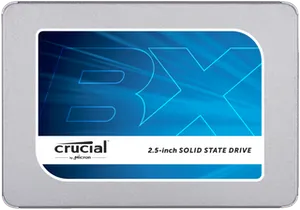
Crucial BX200
SATA 2.5" · SATA/AHCI · SM2256G (4-channel)
Specifications
| Interface | SATA/AHCI |
|---|---|
| Controller | SM2256G (4-channel) |
| NAND Type | Micron 16nm TLC (planar) |
| DRAM Cache | 256MB |
| Warranty | 3 years |
| Active Power | 4.2 W |
| Idle Power | 0.065 W |
| Seq Read | 540 MB/s |
|---|---|
| Seq Write | 490 MB/s |
| Rand Read | 66,000 IOPS |
| Rand Write | 78,000 IOPS |
| Endurance | 72 TBW |
| Launch MSRP | $85 |
| Part Number | CT240BX200SSD1 |
| Seq Read | 540 MB/s |
|---|---|
| Seq Write | 490 MB/s |
| Rand Read | 66,000 IOPS |
| Rand Write | 78,000 IOPS |
| Endurance | 72 TBW |
| Launch MSRP | $150 |
| Part Number | CT480BX200SSD1 |
| Seq Read | 540 MB/s |
|---|---|
| Seq Write | 490 MB/s |
| Rand Read | 66,000 IOPS |
| Rand Write | 78,000 IOPS |
| Endurance | 72 TBW |
| Launch MSRP | $300 |
| Part Number | CT960BX200SSD1 |
Overview
The BX200 is a SATA solid-state drive (SSD) manufactured by Micron's consumer-facing brand Crucial. It was released in November 2015 as a replacement for the BX100 series, targeting first-time SSD buyers upgrading from traditional hard drives. The drives featured Micron's 16nm TLC NAND flash, and marked the company's entry into the TLC consumer SSD market. Despite being marketed as an upgrade path from traditional hard drives, the BX200 received mixed reviews due to performance limitations inherent to its TLC NAND implementation.
Key competitors at the time included Samsung 850 EVO, OCZ Trion 100, and ADATA Premier SP550 (used SK Hynix 16nm TLC with the same SM2256 controller). The BX200 also faced competition from its predecessor, the BX100, which often provided better overall performance due to its MLC NAND, and was being cleared out at competitive prices.
Controller
The BX200 used the Silicon Motion SM2256 controller, a 4-channel design specifically engineered to support TLC NAND with LDPC (Low-Density Parity-Check) error correction. It was labeled as such (SM2256G) on the BX200 units, but utilized custom firmware co-developed between Crucial and Silicon Motion. This single-core controller was designed to improve efficiency but could experience performance bottlenecks when handling multiple operations simultaneously, such as I/O operations alongside garbage collection.
Cache Architecture
The drives incorporated Micron LPDDR3 DRAM cache memory, with capacity varying by model. The 480GB model included 512MB of cache, while the 960GB model featured 1GB (configured as two 512MB chips). Additionally, the BX200 featured a dynamic SLC write cache for improved burst write performance. The SLC cache size was about 6GB for the 480GB model and 12GB for the 960GB model.
NAND Type
Crucial equipped the BX200 with Micron's 128Gbit 16nm TLC (Triple-Level Cell) NAND flash memory, Micron's first implementation of 16nm TLC technology in a consumer SSD. The NAND packages were arranged across the controller's four channels, with the number of packages varying by capacity: 4 packages for 240GB (one per channel), 8 packages for 480GB (two per channel), and 16 packages for 960GB (four per channel). The NAND had ONFi (Open NAND Flash Interface) connectivity rather than the Toggle-mode interface used by some competitors.
Power Consumption
According to specifications:
- Idle Power: 65mW (0.065W)
- DevSleep Power: 15mW (0.015W)
- Active Maximum Power: 4.2W
Independent testing revealed idle power consumption of around 35mW for the 480GB model and 45mW for the 960GB model. However, the drives offered poor power efficiency during write operations, with active power consumption averaging 3.9W (480GB) to 4.28W (960GB) during sustained transfers, and maximum consumption exceeding 6W under heavy workloads.
Reviews
-
“The BX200's steady-state hovers between 200 and 700 IOPS: better than a hard drive, but not what we want to see from a SSD.”
-
“High latency, high cost, low throughput performance and sequential write performance that is half of a modern mechanical drive.”
-
“For the performance you get, we feel the BX200 is overpriced.”