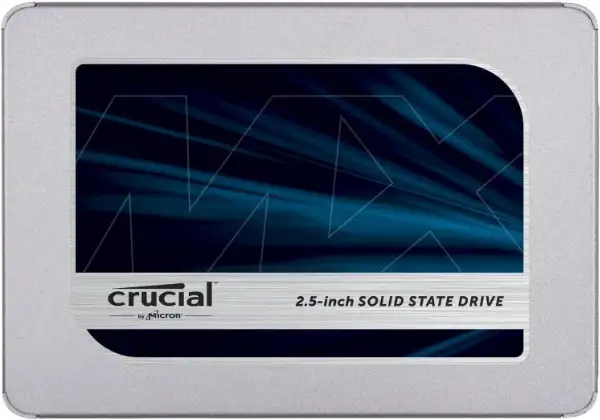
Crucial MX300
SATA 2.5" · SATA 6 Gbps · Marvell 88SS1074
Specifications
| Interface | SATA 6 Gbps |
|---|---|
| Controller | Marvell 88SS1074 |
| NAND Type | 128L TLC (B37R) |
| DRAM Cache | 256MB LPDDR3 |
| Warranty | 3 years |
| Active Power | 0.15 W |
| Idle Power | 0.004 W |
| Seq Read | 530 MB/s |
|---|---|
| Seq Write | 500 MB/s |
| Rand Read | 92,000 IOPS |
| Rand Write | 83,000 IOPS |
| Endurance | 80 TBW |
| Launch MSRP | $85 |
| Part Number | CT275MX300SSD1 |
| Seq Read | 530 MB/s |
|---|---|
| Seq Write | 510 MB/s |
| Rand Read | 92,000 IOPS |
| Rand Write | 83,000 IOPS |
| Endurance | 160 TBW |
| Launch MSRP | $130 |
| Part Number | CT525MX300SSD1 |
| Seq Read | 530 MB/s |
|---|---|
| Seq Write | 510 MB/s |
| Rand Read | 92,000 IOPS |
| Rand Write | 83,000 IOPS |
| Endurance | 220 TBW |
| Launch MSRP | $200 |
| Part Number | CT750MX300SSD1 |
| Seq Read | 530 MB/s |
|---|---|
| Seq Write | 510 MB/s |
| Rand Read | 92,000 IOPS |
| Rand Write | 83,000 IOPS |
| Endurance | 360 TBW |
| Launch MSRP | $260 |
| Part Number | CT1050MX300SSD1 |
| Seq Read | 530 MB/s |
|---|---|
| Seq Write | 510 MB/s |
| Rand Read | 92,000 IOPS |
| Rand Write | 83,000 IOPS |
| Endurance | 400 TBW |
| Launch MSRP | $515 |
| Part Number | CT2050MX300SSD1 |
Overview
Released in June 2016, the Crucial MX300 is a consumer solid-state drive series manufactured by Micron Technology and sold under the company's consumer-facing Crucial brand. It was the first MX-series Crucial SSD to feature Micron's 32-layer 3D TLC (triple-level cell) NAND flash memory – an important transition from the planar NAND found in the MX200 predecessor.
The MX300 was positioned as a mainstream affordable SSD designed to compete directly with Samsung's 850 EVO, which dominated the consumer 3D NAND market at the time. While Samsung had pioneered 3D NAND with the 850 Pro in 2014, Micron took a different approach by targeting value-conscious consumers with 3D TLC (triple-level cell) NAND rather than premium MLC (multi-level cell) variety.
As a result, the MX300 could offer competitive pricing with slightly higher capacities than standard drives, but also unconventional: 525GB instead of 500GB, and 1050GB instead of 1TB. This was also due to its use of larger 384Gbit NAND dies.
Key competing products included the Samsung 850 EVO, SanDisk X400, and other mainstream SATA SSDs using planar NAND. Importantly, the MX300 undercut the 850 EVO by $40-70 depending on capacity while offering comparable or better endurance ratings, though Samsung's drives generally maintained a performance advantage in certain workloads.
Specifications
Controller
The MX300 utilizes the Marvell 88SS1074 (codename "Dean"), a four-channel controller with Low-Density Parity Check (LDPC) error correction. Compared to the previous MX200 series, this newer controller was specifically designed to support 3D NAND technology. The dual-core processor manages eight chip enables per channel (8-CE/ch configuration), providing adequate parallelism across the NAND packages.
Cache
The drives offer a dedicated DRAM cache that stores the flash translation layer (FTL) mapping tables, which are critical for maintaining performance during random read and write operations. In this case, the memory type is LPDDR3-1333MHz from Micron. As is typical, cache capacity varies by model and increases proportionally with capacity. The 2TB model includes two separate DDR3 DRAM packages.
NAND Type
The MX300 used 32-layer 3D TLC NAND manufactured by the Intel-Micron Flash Technologies (IMFT) partnership. Unlike Samsung's charge trap design, the IMFT 3D NAND uses a traditional floating gate architecture. In the MX300, the NAND is organized in 384Gbit (48GB) dies, which is notably larger than the 256Gbit dies common in planar NAND drives. This also explains the non-standard capacities (275GB, 525GB, 750GB, 1050GB, 2050GB) compared to normal power-of-two sizes.
Moving to TLC NAND, which stores more data per cell than MLC, Crucial was able to reduce cost per gigabyte at a slight cost of performance and endurance compared to some MLC-based competitors.
Power Consumption
At a time when SSDs were still competing with conventional hard drives in the consumer storage space, the MX300 could offer exceptional energy efficiency. In DevSleep mode, power consumption drops to 0.004W (4mW). Maximum power draw under heavy workload reaches approximately 5.2W. This efficiency is attributed to Micron's Extreme Energy Efficiency technology, which dynamically adjusts component activity to minimize power consumption while maintaining performance. bit-tech.net (January 13, 2017)
The die size explains the deviation from power-of-two capacities, and means Crucial is using 12 dies in the 525GB drives and 24 in the 1TB model, and overprovisioning by roughly 9 percent to help with wear leveling, reducing write amplification, and ultimately endurance.
Reviews
-
“The MX300 line will probably be the first time we see TLC clearly resulting in an increase of capacity relative to MLC drives across the full range of products, rather than just offering a lower price per GB.”
-
“The MX300 series has matured well in its limited time on the market. Armed with Micron's new 3D TLC, the highest density flash available, the series could redefine the mainstream SSD market with a new low price point.”
-
“"As the first Crucial product leveraging Micron's new 3D TLC NAND, the MX300 SSD promises to bring single-level cell endurance and triple-level cell density and value to consumers."”