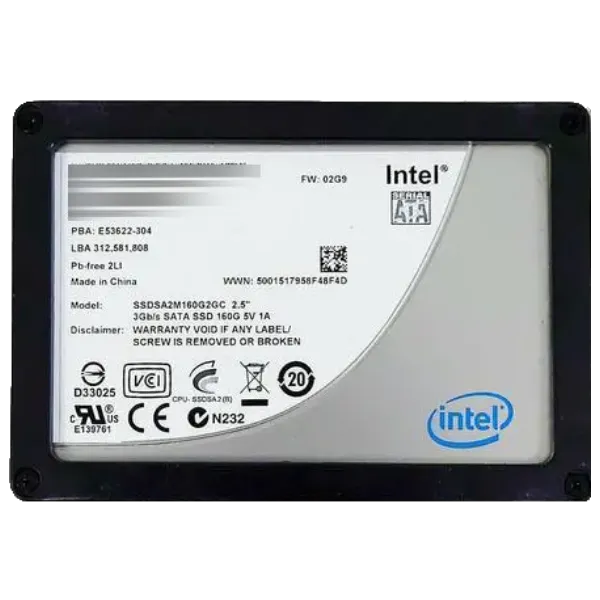
Intel X25-M
SATA 2.5" · SATA II (3 Gbps) · Intel PC29AS21BA0
Specifications
| Interface | SATA II (3 Gbps) |
|---|---|
| Controller | Intel PC29AS21BA0 |
| NAND Type | Intel 34nm MLC |
| DRAM Cache | Yes |
| Warranty | 3 years |
| Seq Read | 250 MB/s |
|---|---|
| Seq Write | 70 MB/s |
| Rand Read | 35,000 IOPS |
| Rand Write | 3,300 IOPS |
| Seq Read | 250 MB/s |
|---|---|
| Seq Write | 100 MB/s |
| Rand Read | 35,000 IOPS |
| Rand Write | 8,600 IOPS |
Overview
The Intel X25-M was Intel's first solid-state drive for consumer and mainstream workstation use, introduced in September 2008. Intel designed both the controller and NAND in-house, using MLC (2-bit-per-cell) flash. The original generation (G1, 50nm) shipped as an 80GB model; a second generation (G2, 34nm) followed in 2009 with improved write performance and added a 160GB SKU.
The G1 reached approximately 3,300 random write IOPS (4K), a known bottleneck compared to its 35,000 random read IOPS. The G2 improved random write to approximately 8,600 IOPS and sequential write to 100 MB/s on the 160GB model. Both generations delivered 250 MB/s sequential read, near the ceiling of the SATA II (3 Gbps) interface.
At launch, most competing drives used SLC NAND at significantly higher cost per gigabyte. The X25-M was among the first mainstream consumer drives built on MLC. It was used as a benchmark reference model in numerous early SSD reviews and is often cited in chronologies of consumer SSD adoption.
Reviews
-
“In our real-world StorageMark 2010 benchmarks the Intel showed a strong lead in playing back both our HTPC and Productivity traces.”
-
“What Intel did with the X25-M is show the world what is possible with MLC flash. You get better than SLC performance, at lower than SLC prices. Despite that, the absolute only thing that bothers me about Intel's X25-M is the price.”