Samsung 870 EVO
SATA 2.5" · SATA 6 Gbps · Samsung MKX
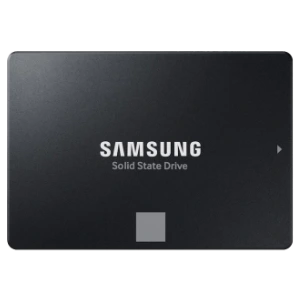
Specifications
| Interface | SATA 6 Gbps |
|---|---|
| Controller | Samsung MKX |
| NAND Type | Samsung 128-layer 3D V-NAND TLC |
| DRAM Cache | LPDDR4 |
| Warranty | 5 years |
| Active Power | 2.2 W |
| Idle Power | 0.05 W |
| Seq Read | 560 MB/s |
|---|---|
| Seq Write | 530 MB/s |
| Rand Read | 98,000 IOPS |
| Rand Write | 88,000 IOPS |
| Endurance | 150 TBW |
| Part Number | MZ-77E250B |
| DRAM Cache | 512MB LPDDR4 |
| Seq Read | 560 MB/s |
|---|---|
| Seq Write | 530 MB/s |
| Rand Read | 98,000 IOPS |
| Rand Write | 88,000 IOPS |
| Endurance | 300 TBW |
| Part Number | MZ-77E500B |
| DRAM Cache | 512MB LPDDR4 |
| Seq Read | 560 MB/s |
|---|---|
| Seq Write | 530 MB/s |
| Rand Read | 98,000 IOPS |
| Rand Write | 88,000 IOPS |
| Endurance | 600 TBW |
| Part Number | MZ-77E1T0B |
| DRAM Cache | 1GB LPDDR4 |
| Seq Read | 560 MB/s |
|---|---|
| Seq Write | 530 MB/s |
| Rand Read | 98,000 IOPS |
| Rand Write | 88,000 IOPS |
| Endurance | 1200 TBW |
| Part Number | MZ-77E2T0B |
| DRAM Cache | 2GB LPDDR4 |
| Seq Read | 560 MB/s |
|---|---|
| Seq Write | 530 MB/s |
| Rand Read | 98,000 IOPS |
| Rand Write | 88,000 IOPS |
| Endurance | 2400 TBW |
| Part Number | MZ-77E4T0B |
| DRAM Cache | 4GB LPDDR4 |
Overview
The Samsung 870 EVO was released in January 2021 and is most likely the final generation of Samsung's EVO SATA line. It replaced the 860 EVO with updated 128-layer V-NAND and the MKX controller. The SATA interface was already mostly saturated, but the 870 EVO's specs: 560 MB/s sequential read and 530 MB/s write, added a modest 10–20 MB/s compared to the predecessor.
By 2021, NVMe SSDs had dropped in price to the point where the SATA vs NVMe price premium had largely closed. The 870 EVO was released into a market where NVMe drives were a realistic and superior choice for most buyers, as M.2 NVMe slots were also common in new PCs at the time. Samsung positioned it for systems without M.2, upgrades to older platforms, and use cases where compatibility matters more than raw throughput.
The TurboWrite SLC cache scales from around 6GB on the 250GB model up to approximately 78GB on the 4TB. Outside the cache, sustained write performance drops, as with all TLC consumer drives. Real-world performance in typical desktop workloads (OS, applications, games) is not distinguishable from the 860 EVO and limited mainly by the SATA bus.
TBW ratings are identical to the 860 EVO at 600 TBW for the 1TB model. The 5-year warranty is unchanged.
Reviews
-
“Knowing that any changes the 870 EVO brings relative to its predecessor will be minor, the most important function of this review is simply to check whether Samsung remains at least consistent with the refresh. As far as we can tell, all seems to be well. Our testing didn't reveal any serious performance regressions, though several signs point to the 870 EVO's SLC caching being a bit less effective. Since this only shows up on tests that are deliberately more strenuous than any common consumer workload, we're not concerned by these results. Otherwise, the 870 EVO continues to be just about as fast as possible for a SATA SSD, and is a fine replacement for the 860 EVO.”
-
“On paper, the 870 EVO seemed like a modest refresh of the last-gen model; however, results from our benchmarks told a slightly different story.”