OCZ
Vertex 2
SATA 2.5" · SATA 2 · SandForce SF-1200
SATA 2.5" 2010 3-year warranty
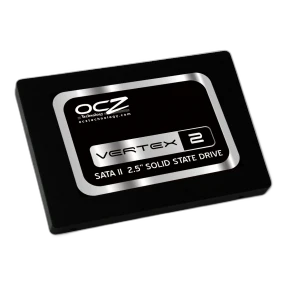
Specs & Capacities
Specifications
| Interface | SATA 2 |
|---|---|
| Controller | SandForce SF-1200 |
| NAND Type | MLC |
| DRAM Cache | N/A |
| Warranty | 3 years |
| Active Power | 2 W |
| Idle Power | 0.5 W |
| Seq Read | 280 MB/s |
| Seq Write | 270 MB/s |
Editor Notes
Overview
The Vertex 2 from OCZ is one of the most popular consumer/client solid state drives to date. It runs on the SATA 2 interface and uses the popular SF-1200 controller from SandForce, like other drives including the Corsair Force series. The SandForce SF-1200 does not make use of DRAM cache, but is nevertheless able to produce consistently high sequential read/write speeds regardless of the drive's capacity, as well as up to 50,000 IOPS (random 4K).
It also comes with TRIM support, which is available in Windows 7 as well as the latest versions of Mac OS X. The TRIM command helps prevent performance deterioration by frequently erasing unused blocks to make new writes faster and more eficient.
Specifications:
- Sequential Read: Up to 280 MB/second
- Sequential Write: Up to 270 MB/second
- NAND type: MLC
- Interface: SATA 2
- Controller: SandForce SF-1200
- Form Factor: 2.5 inch
- DRAM Cache: N/A
- Power Consumption (Active): 2W
- Power Consumption (Idle): 0.5W
- TRIM support: Yes
- SMART support: Yes
- Warranty: 3 years
Available Capacities:
- 40GB - OCZSSD2-2VTX40G
- 50GB - OCZSSD2-2VTX50G
- 60GB - OCZSSD2-2VTX60G
- 80GB - OCZSSD2-2VTX80G
- 100GB - OCZSSD2-2VTX100G
- 120GB - OCZSSD2-2VTX120G
- 160GB - OCZSSD2-2VTX160G
- 200GB - OCZSSD2-2VTX200G
- 320GB - OCZSSD2-2VTX320G
- 400GB - OCZSSD2-2VTX400G
External Reviews
Reviews
-
“The drives have done very well in our tests as well as in my personal systems, although I still recommend waiting to see if any strange bugs crop up over the coming months if you’re not fond of making potentially risky purchases.”
-
“It's not a secret that with the SF1200 series SSDs, OCZ brings a great new SSD series to the market. On certain applications we see baffling numbers reaching advertised speeds.”