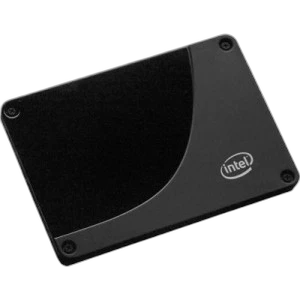
X25-E Extreme
SATA 2.5" · SATA 2 · Intel PC29AS21BA0
Specifications
| Interface | SATA 2 |
|---|---|
| Controller | Intel PC29AS21BA0 |
| NAND Type | SLC |
| DRAM Cache | N/A |
| Warranty | 3 years |
| Active Power | 2.4 W |
| Idle Power | 0.06 W |
| Seq Read | 250 MB/s |
| Seq Write | 170 MB/s |
Overview
Intel's X25-E Extreme uses SLC (Single-Level Cell) NAND flash and is therefore a professional enterprise product by default, not least considering that SLC drives are considerably more expensive than their MLC (Multi-Level Cell) counterparts. There is of course a flip side to the coin, which is greatly improved durability compared to the MLC NAND found in consumer drives, making it much better suited for enterprise users. Write endurance is rated at 1 petabyte of random writes for the 32GB drive and 2 petabytes of random writes for the 64GB drive.
It is currently available in two capacities - 32GB and 64GB - with nearly identical specifications. The X25-E series was introduced in 2008, but are still available on the market at this writing. Sustained sequential read and write speeds are 250MB/s and 170MB/s respectively, thus exceeding the read/write performance offered by the same generation X25-M series. The IOPS figure for 4K random reads is 35,000 and for 4K random writes, 3,300.
Specifications:
- Sequential Read: 250 MB/second
- Sequential Write: Up to 170 MB/second
- NAND type: SLC
- Interface: SATA 2
- Controller: Intel
- Form Factor: 2.5 inch
- DRAM Cache: N/A
- Power Consumption (Active): 2.4 W (32GB) 2.6 W (64GB)
- Power Consumption (Idle): 0.06 W
- TRIM support: N/A
- SMART support: Yes
Pricing and Availability:
Reviews
-
“For those who put a premium on storage subsystem performance, the X25-E actually represents rather good value.”
-
“Sophisticated flash memory technology has reached a level at which a single storage product is capable of delivering performance levels formerly reached only on complex RAID arrays with 6-12 hard drives.”