Aorus RGB M.2 NVMe
PCIe M.2 · PCIe 3.0 x4, NVMe 1.3 · Phison E12
Specifications
| Interface | PCIe 3.0 x4, NVMe 1.3 |
|---|---|
| Controller | Phison E12 |
| NAND Type | Toshiba 64-layer 3D TLC |
| DRAM Cache | SK Hynix DDR4 |
| Warranty | 5 years |
| Seq Read | 3,100 MB/s |
|---|---|
| Seq Write | 1,050 MB/s |
| Rand Read | 180,000 IOPS |
| Rand Write | 240,000 IOPS |
| Endurance | 380 TBW |
| Part Number | GP-ASM2NE6256GTTD |
| Seq Read | 3,480 MB/s |
|---|---|
| Seq Write | 2,000 MB/s |
| Rand Read | 360,000 IOPS |
| Rand Write | 440,000 IOPS |
| Endurance | 800 TBW |
| Part Number | GP-ASM2NE6512GTTD |
Overview
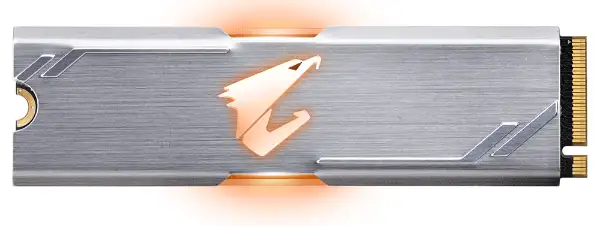
As the name implies, Gigabyte's Aorus RGB NVMe M.2 SSD is a drive with added bling in the form of RGB LEDs. It's not the first RGB-equipped SSD, but it is quite possibly the fastest option so far (2019). It also comes with a heatsink. In addition to this M.2 variant, Gigabyte also offers the drive as a PCIe add-in card. Both use the same controller and NAND.
Overview: Memory Type, Controller and Cache
Like many other high-end M.2 drives on the market today, the Aorus RGB SSD uses 64-layer 3D TLC (triple-level cell) NAND, in this case from Toshiba. The drive's Phison E12 controller is also shared with other similar SSDs on the market, such as Patriot's Viper VPN100 and the MyDigitalSSD BPX Pro).
Since TLC memory is not particularly fast in itself, the Gigabyte Aorus uses an 8 GB (512 GB) SLC-mode cache to speed up transfers. The drive also has a DDR4 DRAM buffer.
Specifications
The Aorus drive is only available in two capacities: 256 GB and 512 GB. And like all SSDs except for the Intel Optane lineup, higher capacities offer better performance due to improved use of parallelization. This difference is particularly noticeable when comparing small capacities, which is the case here.
It's possible that the included heatsink makes the Auros drive less sensitive to thermal throttling compared to other high-end M.2 SSDs without a heatsink. As of late 2019, Gigabyte also offers a class-leading PCIe 4.0 SSD with the Aorus branding.
Power Consumption (Laptop Suitability)
Idle power consumption is 272mW according to the manufacturer. The average read power consumption is 5485mW, while write power draw is 4085mW. Due to the RGB feature and the attached heatsink, the Aorus is not intended for laptop use.
Warranty and Endurance Rating
Gigabyte offers a 5-year limited warranty, which is the most common limitation for high-end SSDs. The terabytes written (TBW) ratings are above average for the respective capacities.
Reviews
-
“Gigabyte’s AORUS RGB brings high-end performance, tons of write endurance, and a 5-year warranty all wrapped in a stylish heatsink and RGB lighting, making it a great buy for enthusiasts and casual users alike.”
-
“The performance difference between the 256GB and 512GB drives is night and day with the 512GB seeing a significant performance increase.”