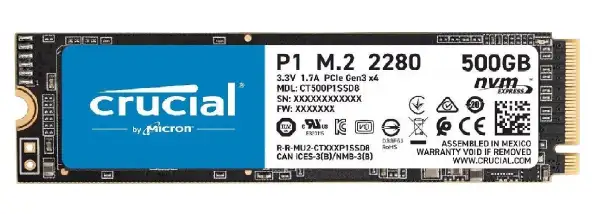
Crucial P1
PCIe M.2 · PCIe 3.0 x4, NVMe 1.3 · Silicon Motion SM2263
Specifications
| Interface | PCIe 3.0 x4, NVMe 1.3 |
|---|---|
| Controller | Silicon Motion SM2263 |
| NAND Type | Micron 64-layer 3D QLC NAND |
| DRAM Cache | 512MB DDR3 |
| Warranty | 5 years |
| Seq Read | 1,900 MB/s |
|---|---|
| Seq Write | 950 MB/s |
| Rand Read | 90,000 IOPS |
| Rand Write | 220,000 IOPS |
| Endurance | 100 TBW |
| Seq Read | 2,000 MB/s |
|---|---|
| Seq Write | 1,700 MB/s |
| Rand Read | 170,000 IOPS |
| Rand Write | 240,000 IOPS |
| Endurance | 200 TBW |
| Seq Read | 2,000 MB/s |
|---|---|
| Seq Write | 1,750 MB/s |
| Rand Read | 250,000 IOPS |
| Rand Write | 250,000 IOPS |
| Endurance | 400 TBW |
Overview
The Crucial P1 was one of the first SSDs of its kind to use QLC, or quad-level cell, NAND Flash memory. This makes it an entry-level alternative among other drives using the PCI Express/NVMe interface/protocol. Performance and endurance ratings are lower than average in the segment, but in general, the P1 will still be faster than SATA SSDs.
Memory Type, Controller and Cache
Quad-level cell NAND has to work with four bits per cell, which negatively affects durability and performance compared to triple-level cell (TLC) and multi-level cell (MLC). There are however also advantages to an increased memory cell density, most notably more efficient manufacturing and in turn, lower prices.
The Crucial P1 does not use a proprietary controller. Instead, Micron has opted for an SM2263 from Silicon Motion. This is a 4-channel controller intended for entry-level NVMe SSDs. Contrary to the naming, the SM2263 will be slower than the 8-channel SM2262 controller which is used in several higher-end SSDs.
To compensate for the QLC memory chips' lower performance, particularly in the write area, the Crucial P1 uses a single-level cell or SLC-type cache to maintain a write performance that exceeds SATA-level speeds. When the SLC cache is exhausted, performance will drop well below most mainstream 2.5" SATA SSDs.
The amount of NAND used in SLC mode is allocated dynamically. All capacities of the Crucial P1 also include a DRAM DDR3 (512GB and 1TB capacities) or DDR4 (2TB capacity) cache buffer.
Performance
As with all other SSDs, the Crucial P1's performance increases with the drive's capacity up to a certain point, meaning that the 2TB capacity is faster than the 1TB, which in turn is faster than the 512GB model.
Due to the comparatively low-end nature of QLC memory, no such SSD is among the segment's top performers.
Power Consumption
According to the official numbers, the Crucial P1's maximum power draw is 8W (controller: 9W). While idle, and on average, it should be much less. TweakTown has performed a practical battery life test with P1 and found it to be slightly better than the popular Samsung 970 EVO, but not as efficient as the Intel 760p.
Warranty and Endurance Rating
Micron offers an industry-standard 5-year warranty with the Crucial P1. However, due to the QLC memory chips, endurance ratings are comparatively (very) low at:
- 512 GB: 100 TBW
- 1 TB: 200 TBW
- 2 TB: 400 TBW
Measured as drive writes per day (DWPD), these numbers equal about 0.1 DWPD for the warranty duration.
Reviews
-
“For performance, the drive did well when considering the target audience and comparing it to another QLC product in the same segment.”
-
“The 500GB Crucial P1 isn't the perfect SSD for all users, but it's not too far off from being a very good drive for many.”