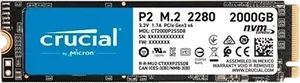
Crucial P2
PCIe M.2 · PCIe 3.0 x4, NVMe 1.3 · Phison E13T
Specifications
| Interface | PCIe 3.0 x4, NVMe 1.3 |
|---|---|
| Controller | Phison E13T |
| NAND Type | 96L Micron TLC (B27A) |
| DRAM Cache | Yes |
| Warranty | 5 years |
| Active Power | 3.5 W |
| Idle Power | 0.8 W |
| Seq Read | 2,100 MB/s |
|---|---|
| Seq Write | 1,150 MB/s |
| Rand Read | 170,000 IOPS |
| Rand Write | 260,000 IOPS |
| Endurance | 150 TBW |
| Part Number | CT250P2SSD8 |
| Seq Read | 2,300 MB/s |
|---|---|
| Seq Write | 940 MB/s |
| Rand Read | 95,000 IOPS |
| Rand Write | 215,000 IOPS |
| Endurance | 150 TBW |
| Part Number | CT500P2SSD8 |
| Seq Read | 2,400 MB/s |
|---|---|
| Seq Write | 1,800 MB/s |
| Rand Read | 430,000 IOPS |
| Rand Write | 430,000 IOPS |
| Endurance | 300 TBW |
| Part Number | CT1000P2SSD8 |
| Seq Read | 2,400 MB/s |
|---|---|
| Seq Write | 1,900 MB/s |
| Rand Read | 430,000 IOPS |
| Rand Write | 430,000 IOPS |
| Endurance | 600 TBW |
| Part Number | CT2000P2SSD8 |
Overview
The Crucial P2 is an entry-level NVMe solid-state drive (SSD) manufactured by Crucial, the consumer brand of Micron Technology. Announced in April 2020 alongside the higher-end P5, the P2 was designed to provide affordable NVMe performance for mainstream users transitioning from SATA-based storage solutions. It became controversial when Crucial quietly switched from TLC to QLC NAND in later production runs without changing the model designation, resulting in significantly reduced performance.
The P2 was positioned as a successor to Crucial's first NVMe offering, the QLC-based P1. However, instead of continuing with QLC NAND initially, Crucial opted to use TLC (Triple-Level Cell) NAND for the original P2 models, combined with a DRAM-less architecture to save costs while maintaining acceptable performance. Initial capacity offerings were limited to 250GB and 500GB, with 1TB and 2TB models added later to the lineup.
Key competitors to the P2 in the value segment included the Western Digital Blue SN550, Kingston NV1, Samsung 980 (non-PRO), and Intel SSD 665p.
The P2's initial TLC configuration allowed it to compete effectively on price/performance. However, the undisclosed switch to QLC NAND damaged its market position, with many reviewers subsequently placing it on "do not buy" lists or similar due to the uncertainty surrounding which variant consumers would receive.
Specifications
Controller
The Phison PS5013-E13T controller is a budget-oriented, single-core design optimized for cost-effectiveness and low power consumption. It's a DRAM-less controller that features four channels and supports PCIe Gen 3.0 x4 interface with NVMe 1.3 protocol compliance. The E13T differentiates itself from contemporary competitors by implementing Host Memory Buffer (HMB) technology, which utilizes a small portion of system RAM to compensate for the absence of dedicated DRAM cache.
Cache
Unlike premium NVMe drives that incorporate dedicated DRAM cache, the P2 relies entirely on the Host Memory Buffer feature available in Windows 10 and newer operating systems. This allows the SSD to use system memory for mapping tables and metadata storage. Additionally, the drive implements dynamic SLC caching, where a portion of the NAND operates in single-bit mode to accelerate write operations.
NAND Type
The P2's NAND configuration became a significant point of controversy. Original models shipped with Micron's 96-layer 3D TLC NAND, providing the advertised performance characteristics. However, Crucial later transitioned to using 96-layer QLC (Quad-Level Cell) NAND without providing clear differentiation for consumers. Some drives also reportedly used 176-layer TLC NAND in certain capacities.
This switch resulted in performance degradation – testing revealed that QLC variants delivered significantly lower sustained write speeds dropping to USB 2.0-like levels of 40 MB/s once the SLC cache was exhausted. The only visual indicator of the QLC variant was a "UK/CA" marking on the packaging and different firmware revisions.
Power Consumption
Power efficiency was one of the P2's stronger attributes, particularly important for laptop users. Official specifications:
- Active Power: 3.5W maximum during operation
- Idle Power: 800mW when idle
The drive supports NVMe Autonomous Power State Transition (APST), enabling automatic transitions between multiple power states based on activity levels. This feature, combined with the relatively efficient Phison E13T controller, made the P2 suitable for mobile computing where battery life is a priority.
Reviews
-
“... we do not recommend purchasing this drive. In this article, we have also inserted additional albums in each test category to reflect the real performance you'll get when purchasing this drive today.”
-
“Though the P2 is one of the more weak-performing TLC-based consumer SSDs we’ve seen, in the end, Crucial achieved exactly what it set out to do: create an ultra-affordable NVMe drive that is priced at the expense of write performance.”
-
“The P2 makes for a fairly solid entry-level drive and perfect SATA replacement, but adding in cost, there are simply better drives on the market for your hard earned dollars.”