Force MP600
PCIe M.2 · PCIe 4.0 x4, NVMe 1.4 · Phison E16
Specifications
| Interface | PCIe 4.0 x4, NVMe 1.4 |
|---|---|
| Controller | Phison E16 |
| NAND Type | Toshiba 96-layer 3D TLC |
| DRAM Cache | Yes |
| Warranty | 5 years |
| Seq Read | 4,950 MB/s |
|---|---|
| Seq Write | — |
| Rand Read | — |
| Rand Write | — |
| Endurance | — |
| Seq Read | 4,950 MB/s |
|---|---|
| Seq Write | 4,250 MB/s |
| Rand Read | 680,000 IOPS |
| Rand Write | 600,000 IOPS |
| Endurance | 1800 TBW |
| Seq Read | 4,950 MB/s |
|---|---|
| Seq Write | — |
| Rand Read | — |
| Rand Write | — |
| Endurance | — |
| Seq Read | 4,950 MB/s |
|---|---|
| Seq Write | 950 MB/s |
| Rand Read | — |
| Rand Write | — |
| Endurance | — |
| Seq Read | 4,950 MB/s |
|---|---|
| Seq Write | 950 MB/s |
| Rand Read | — |
| Rand Write | — |
| Endurance | — |
Overview
Corsair was one of the first manufacturers – along with Gigabyte and Sabrent – to release a consumer SSD in the M.2 form factor (or any form factor) that utilizes the PCI Express (PCIe) 4.0 interface. At the time (2019), the only commercially available consumer platform supporting the interface was AMD's X570 chipset in combination with a Ryzen 3000-series CPU.
Overview: Memory Type, Controller, and Cache
The Corsair Force MP600 (this drive), Gigabyte's Gen4 Aorus and the Sabrent Rocket Gen4 were the first PCIe 4.0-compatible M.2 drives on the consumer market, and they have a lot in common. All of them use the same 96-layer Toshiba TLC (triple-level cell) NAND memory in combination with the Phison E16 controller. Similarly, like most high-end TLC-based SSDs, a DDR4 DRAM buffer and SLC-mode cache help this drive reach the advertised transfer rates.
Corsair MP600 Vs. Aorus Gen4 Vs. Sabrent Rocket Gen4
Corsair's MP600 comes in 500 GB, 1 TB, and 2 TB capacities; 256 GB and 512 GB. The maximum sequential read speed is marginally lower than its competitors at 4,950 MB/s and the same goes for sequential writes, which caps out at 4,250MB/s (lower in the 500 GB model: 2,500 MB/s). In actual use, users are unlikely to notice the difference and the transfer rates are nevertheless higher than all PCIe 3.0 SSDs.
There are apparently firmware differences and a slight performance gap between the Gigabyte Aorus Gen4, Sabrent Rocket Gen4, and the MP500 although the memory chips/controller combination are identical.
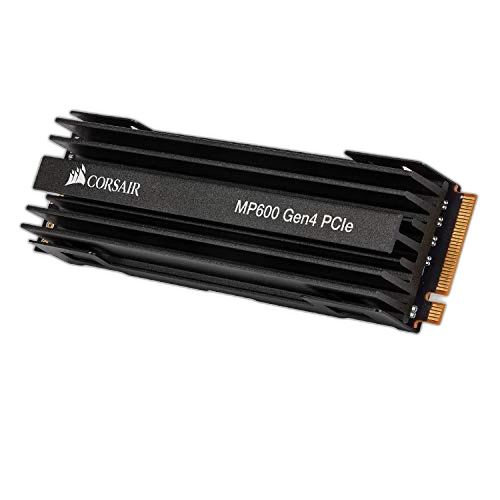
The Corsair drive is equipped with a heat sink, which is a common sight among high-end PCI SSDs as these devices have a tendency to run hot under load.
Power Consumption (Laptop Suitability)
Due to the heat sink covering the device, the Corsair Force MP600 is impossible to install in the vast majority of laptops. Even if removed, few if any laptops come with a PCIe 4.0 M.2 slot at the end of 2019 and early 2020.
Warranty and Endurance Rating
Corsair follows the industry standard with a 5-year limited warranty for the Force MP500. The endurance ratings in TBW (terabytes or total bytes written) are very impressive at 900 TBW (500GB), 1,800 TBW (1TB) and 3,600 TBW (2TB). Official presentation (Corsair):
Reviews
-
“It shatters records given the right conditions, but on in other workloads, you are down to high-end class TLC NVMe performance.”
-
“The MP600 exemplifies quality from top to bottom. From its attractive and highly functional heat sink design, to its 5-year warranty, to its endurance rating - SSDs don't get much better than this.”