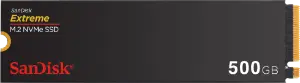
SanDisk Extreme M.2 NVMe SSD (2023)
PCIe M.2 · PCIe 4.0 x4, NVMe 1.4 · Polaris MP16+ (4-channel)*
Specifications
| Interface | PCIe 4.0 x4, NVMe 1.4 |
|---|---|
| Controller | Polaris MP16+ (4-channel)* |
| NAND Type | Kioxia BiCS5 (112L TLC)* |
| DRAM Cache | Yes |
| Warranty | 5 years |
| Seq Read | 5,000 MB/s |
|---|---|
| Seq Write | 4,000 MB/s |
| Rand Read | 460,000 IOPS |
| Rand Write | 800,000 IOPS |
| Endurance | 300 TBW |
| Part Number | SDSSDX3N-500G-G26 |
| Seq Read | 5,150 MB/s |
|---|---|
| Seq Write | 4,900 MB/s |
| Rand Read | 740,000 IOPS |
| Rand Write | 800,000 IOPS |
| Endurance | 600 TBW |
| Part Number | SDSSDX3N-1T00-G26 |
| Seq Read | 5,150 MB/s |
|---|---|
| Seq Write | 4,850 MB/s |
| Rand Read | 650,000 IOPS |
| Rand Write | 800,000 IOPS |
| Endurance | 1200 TBW |
| Part Number | SDSSDX3N-2T00-G26 |
Overview
Released in 2023, the SanDisk Extreme M.2 NVMe SSD is a PCIe Gen 4.0 solid-state drive manufactured by Western Digital under the SanDisk brand. Based on its specifications, it is likely a SanDisk-branded variant of the WD Black SN770 from 2022.
Note that the SanDisk Extreme M.2 NVMe from 2023 is distinct from the earlier SanDisk Extreme Pro M.2 NVMe 3D SSD (released in 2018), which was a PCIe Gen 3.0 drive. The newer Extreme model leverages the PCIe Gen 4.0 interface and offers identical performance to the SN770, with sequential read speeds up to 5,150 MB/s on the 1TB and 2TB models.
The SanDisk Extreme occupies the mid-tier performance segment of the PCIe Gen 4.0 SSD market. It competes directly with drives such as the manufacturer's own WD Black SN770, Samsung 990 EVO (non-Plus), and SK Hynix Platinum P41. It is positioned below flagship models like the Samsung 990 PRO and WD Black SN850X, but offers competitive performance in its segment.
Specifications
These specifications are identical to the WD Black SN770, but there is no 250GB variant of the SanDisk Extreme M.2 NVMe.
Controller
While Western Digital has not publicly disclosed the specific controller model used in the SanDisk Extreme M.2 NVMe, it can be assumed to be the in-house developed Polaris MP16 – a DRAM-less design that uses Host Memory Buffer (HMB) technology to leverage system RAM for mapping table storage, which helps reduce costs while maintaining competitive performance.
Cache Architecture
The drive features SanDisk's nCache 4.0 technology, an evolution from the nCache 3.0 system used in previous generations. This technology employs a dynamic SLC (Single-Level Cell) cache that treats a portion of the TLC NAND as faster SLC memory for improved write performance during burst workloads. Unlike earlier implementations, the SLC cache is substantial, potentially utilizing up to 50% or more of the drive's total capacity.
NAND Type
SanDisk does not officially disclose the exact type of NAND memory chips used for the Extreme NVMe SSD, but the most probable candidate is BiCS5 112-layer 3D TLC (the same type used in the WD Black SN770 and many other WD/SanDisk SSDs). This fifth-generation BiCS flash allegedly offers twice the write performance of its 96-layer BiCS4 predecessor.
Power Consumption
Specific power consumption figures have not been officially published but are likely to be in line with the SN770, meaning that the SanDisk Extreme M.2 NVMe SSD is highly efficient, and therefore suitable for laptops and other battery-powered devices.