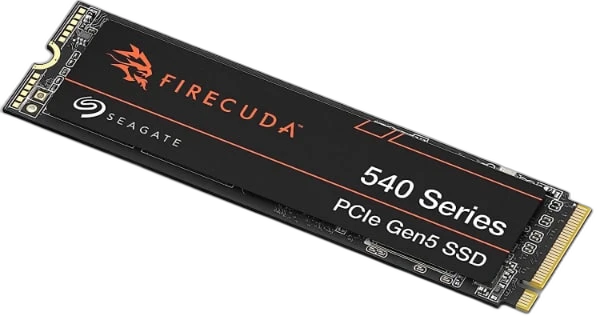
Seagate FireCuda 540
PCIe M.2 · PCIe 5.0 x4, NVMe 2.0 · Phison E26
Specifications
| Interface | PCIe 5.0 x4, NVMe 2.0 |
|---|---|
| Controller | Phison E26 |
| NAND Type | 232-layer TLC (1600 MT/s) |
| DRAM Cache | Yes |
| Warranty | 5 years |
| Seq Read | 9,500 MB/s |
|---|---|
| Seq Write | 8,500 MB/s |
| Rand Read | 1,500,000 IOPS |
| Rand Write | 1,300,000 IOPS |
| Endurance | 1000 TBW |
| Seq Read | 10,000 MB/s |
|---|---|
| Seq Write | 10,000 MB/s |
| Rand Read | 1,500,000 IOPS |
| Rand Write | 1,700,000 IOPS |
| Endurance | 2000 TBW |
Overview
Launched in June 2023, the Seagate FireCuda 540 is a PCI-Express 5.0 (Gen5)-enabled solid state drive in the M.2 form factor. Like other early Gen5 SSDs, the FireCuda 540 uses the Phison PS5026-E26 controller in combination with 232-layer TLC NAND memory and a large DDR4 cache.
Specifications: FireCuda 540 Vs. Crucial T700
With sequential read/write performance of 10,000 MB/s, the 2TB Seagate FireCuda is one of the fastest M.2 SSDs at launch, surpassed only by the Crucial T700 as of mid-2023. However, it has several competitors that offer the same transfer rates (including random IOPS performance), such as the Aorus Gen5 10000, Corsair MP700, and MSI Spatium M570.
To run at these speeds, a system with PCI-Express 5.0 capabilities is required. In the consumer space 2023, this includes PCs based on an AMD Ryzen 7000-series processor and a B650 motherboard or better with a Gen5 M.2 slot. Select high-end Intel Z790 motherboards for 13th-gen Core CPUs may also support a single Gen5 SSD.
Note that all Gen5 SSDs using the Phison E26 controller generate considerably more heat than the average Gen4 SSD. Some manufacturers therefore ship these drives with an included heatsink (and/or a fan) to prevent them from throttling. The Seagate FireCuda 540 does not come with a heatsink, but using one is recommended.
Controller and NAND
The striking similarities between these early PCIe Gen5-capable M.2 drives are due to the fact that they all use essentially the same hardware. This includes a Phison E26 controller, a substantial onboard DDR4 cache, and 232-layer TLC memory.
What differs is primarily the rated speed of the NAND memory chips. The FireCuda 540 and most early competitors use Micron B58R NAND running at 1,600 MT/s, whereas the Crucial T700 and other upcoming Gen5 SSDs with the E26 controller use the same NAND running at 2,000 MT/s or 2,400 MT/s.
Gen5 SSDs with competing controllers from Silicon Motion (SM2508) and InnoGrit (IG5666) should become available later in 2023.
Endurance and Warranty
Seagate's drive is nevertheless unique thanks to the generous endurance ratings. Both the 1TB and 2TB models of the FireCuda 540 come with market-leading endurance ratings of 1,000 TBW (terabytes written) and 2,000 TBW, respectively.
Reviews
-
“In terms of performance, the FireCuda 540 demonstrated mixed results at times. While it excelled in 4K random reads, delivering high IOPS and low latency, it performed less favorably in 4K random writes and sequential writes.”
-
“Seagate's FireCuda 540 2TB is offering best-in-class overall performance along with best-in-class endurance ...”