SanDisk Ultra II
SATA 2.5" · SATA 6 Gbps · Marvell 88SS1074
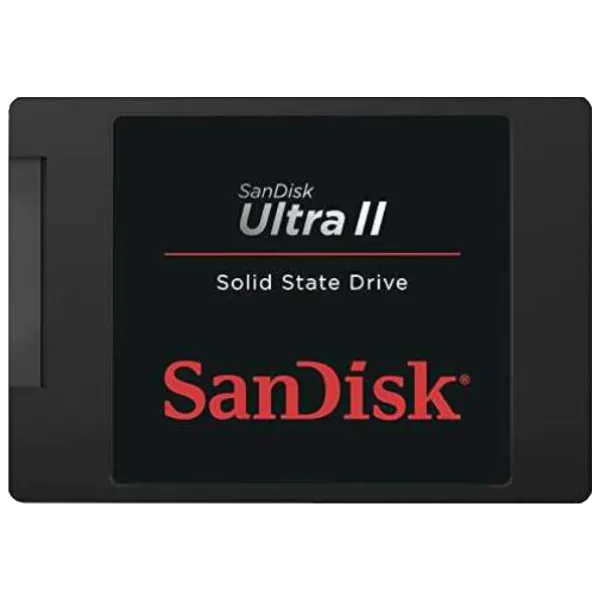
Specifications
| Interface | SATA 6 Gbps |
|---|---|
| Controller | Marvell 88SS1074 |
| NAND Type | SanDisk A19 19nm TLC |
| Warranty | 3 years |
| Seq Read | 550 MB/s |
|---|---|
| Seq Write | 500 MB/s |
| Part Number | SDSSDHII-120G |
| Seq Read | 550 MB/s |
|---|---|
| Seq Write | 500 MB/s |
| Part Number | SDSSDHII-240G |
| Seq Read | 550 MB/s |
|---|---|
| Seq Write | 500 MB/s |
| Part Number | SDSSDHII-480G |
| Seq Read | 550 MB/s |
|---|---|
| Seq Write | 500 MB/s |
| Part Number | SDSSDHII-960G |
Overview
SanDisk's Ultra II from 2014 was one of the earliest consumer SATA SSDs built on TLC (triple-level cell) NAND. It used SanDisk's own 19nm (A19) TLC flash and their proprietary nCache 2.0 technology, meaning that a portion of NAND operated in SLC mode as a write buffer, to achieve 550 MB/s sequential read and 500 MB/s write. No dedicated DRAM cache was included.
Sustained write performance beyond the nCache buffer was lower than DRAM-equipped competing drives, a limitation common to all consumer TLC SATA SSDs of this era. The Ultra II's lower price versus MLC drives reflected TLC NAND's lower manufacturing cost per gigabyte.
It was followed by the SanDisk Ultra 3D, which used 3D (stacked) TLC NAND, with higher endurance ratings and more consistent write throughput.
Reviews
-
“The SanDisk Ultra II SSD has low pricing and power consumption with speedy and consistent performance so it earns our Legit Reviews recommended award!”
-
“Overall, due to the performance and low entry level price point, we feel that the SanDisk Ultra II is deserving of our Top Value award.”
-
“There are only two minor shortcomings that I see in the Ultra II. The first one is peak performance, which is not on par with the MX100 and 840 EVO. For very light workloads (web browsing, email, Office, etc.) that is not a concern, but users with heavier workloads (though not heavy workloads, just something more than basic web browsing and email; e.g. gaming and photo editing) may get slightly better performance with the MX100 or 840 EVO. The other is the lack of hardware encryption.”