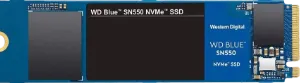
Western Digital WD Blue SN550
PCIe M.2 · PCIe 3.0 x4, NVMe 1.4 · Polaris MP16 (4-channel)
Specifications
| Interface | PCIe 3.0 x4, NVMe 1.4 |
|---|---|
| Controller | Polaris MP16 (4-channel) |
| NAND Type | BiCS4 (96L TLC) |
| DRAM Cache | Yes |
| Warranty | 5 years |
| Active Power | 0.075 W |
| Idle Power | 0.005 W |
| Seq Read | 2,400 MB/s |
|---|---|
| Seq Write | 950 MB/s |
| Rand Read | 165,000 IOPS |
| Rand Write | 160,000 IOPS |
| Endurance | 150 TBW |
| Part Number | WDS250G2B0C |
| Seq Read | 2,400 MB/s |
|---|---|
| Seq Write | 1,750 MB/s |
| Rand Read | 250,000 IOPS |
| Rand Write | 175,000 IOPS |
| Endurance | 300 TBW |
| Part Number | WDS500G2B0C |
| Seq Read | 2,400 MB/s |
|---|---|
| Seq Write | 1,950 MB/s |
| Rand Read | 345,000 IOPS |
| Rand Write | 385,000 IOPS |
| Endurance | 600 TBW |
| Part Number | WDS100T2B0C |
| Seq Read | 2,600 MB/s |
|---|---|
| Seq Write | 1,800 MB/s |
| Rand Read | 360,000 IOPS |
| Rand Write | 384,000 IOPS |
| Endurance | 900 TBW |
| Part Number | WDS200T2B0C |
Overview
Announced in December 2019, the WD Blue SN550 is an entry-level M.2 NVMe solid-state drive (SSD) manufactured by Western Digital. It's the successor to the WD Blue SN500 and was WD/SanDisk's mainstream NVMe offering in 2020, positioned between the high-end WD Black series and budget-oriented WD Green series. The drive was designed to deliver NVMe performance at price points competitive with SATA SSDs, targeting mainstream users seeking an affordable upgrade path from traditional SATA storage.
With launch MSRPs of $54.99, $64.99, and $99.99 for the 250GB, 500GB, and 1TB models respectively, the SN550 was positioned to compete directly with QLC NAND-based drives while offering the advantages of superior TLC NAND technology. The drive's pricing strategy aimed to make NVMe storage accessible to mainstream users, with launch MSRPs of $54.99, $64.99, and $99.99 for the 250GB, 500GB, and 1TB models respectively. It was marketed as delivering up to four times the speed of SATA SSDs to highlight the advantages of upgrading from SATA-based storage.
Technical Specifications
Controller
The SN550 uses a Western Digital-designed controller (labeled SanDisk 20-82-01008-A1), also known as Polaris MP16. This controller is based on the same architecture as the controller found in the higher-end WD Black SN750. However, the SN550's controller features a scaled-down 4-channel design compared to the 8-channel configuration in the Black series, and possibly uses fewer cores or a smaller manufacturing process node to achieve its compact size and lower power consumption. It incorporates a small amount of SRAM for caching purposes rather than utilizing external DRAM, making it a DRAM-less design. Instead of physical DRAM, it leverages NVMe's Host Memory Buffer (HMB) feature, allocating 64MB of the host system's DRAM to help accelerate Flash Translation Layer (FTL) tasks and maintain responsive performance.
NAND Type Controversy
Originally, the SN550 used SanDisk-branded 96-layer BiCS4 3D TLC (Triple-Level Cell) NAND flash memory manufactured through the Kioxia partnership. These NAND chips carried the part number 60523 1T00 on initial production units. The drive uses a single NAND package design even for the 1TB model, indicating the use of high-density 512Gb dies. This single-package approach contributes to the drive's efficient thermal design and single-sided form factor.
In 2021, Western Digital made a controversial revision to the drive, changing to QLC NAND flash with part number 002031 1T00, which exhibited inferior performance characteristics, particularly in sustained write scenarios. The company later offered to replace QLC-based SN550 SSDs with TLC-based alternatives.
Like most other SSDs of its kind, the SN550 implements a dynamic SLC (single-level cell) write cache to enhance burst write performance. The cache size is approximately 12GB for the 1TB model, but the size varies by capacity. When operating within the SLC cache, the drive can achieve its rated sequential write speeds. Once the SLC cache is exhausted, write performance drops significantly. Original versions of the drive maintained approximately 880 MB/s sustained write speeds after cache exhaustion, whereas later revisions showed reduced performance in this area. The drive does not feature a dedicated DRAM cache, instead relying on the controller's internal SRAM and the Host Memory Buffer feature for mapping table storage.
Power Consumption
The SN550 was designed with power efficiency as a key priority. According to official specifications, the drive consumes:
- Average active power: 75mW (measured using MobileMark 2014)
- Low power state (PS3): 30mW
- Sleep state (PS4): 5mW
- Maximum operating power: 3.5W (250GB-1TB models), 3.9W (2TB model)
These low power consumption figures made the SN550 particularly suitable for laptops, where thermal management and battery life are critical considerations.
Reviews
-
“The budget-priced, DRAM-less WD Blue SN550 outpaced its chief competition in the form of AData's Swordfish in both the read and write tests ...”
-
“WD's Blue SN550 is one of the most consistent performing low-cost NVMe SSDs available. Even though it has a small SLC write cache, when you hammer it with heavy writes, its slowest performance will still remain acceptable”
-
“... you are essentially getting a PCIe/NVMe drive for just slightly more than the price of an average 2.5" SATA SSD”