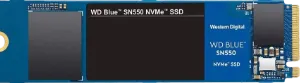
Western Digital WD Blue SN550
PCIe M.2 · PCIe 3.0 x4, NVMe 1.4 · Polaris MP16 (4-channel)
Specifications
| Interface | PCIe 3.0 x4, NVMe 1.4 |
|---|---|
| Controller | Polaris MP16 (4-channel) |
| NAND Type | BiCS4 (96L TLC) |
| DRAM Cache | N/A (HMB) |
| Warranty | 5 years |
| Active Power | 0.075 W |
| Idle Power | 0.005 W |
| Seq Read | 2,400 MB/s |
|---|---|
| Seq Write | 950 MB/s |
| Rand Read | 165,000 IOPS |
| Rand Write | 160,000 IOPS |
| Endurance | 150 TBW |
| Part Number | WDS250G2B0C |
| Seq Read | 2,400 MB/s |
|---|---|
| Seq Write | 1,750 MB/s |
| Rand Read | 250,000 IOPS |
| Rand Write | 175,000 IOPS |
| Endurance | 300 TBW |
| Part Number | WDS500G2B0C |
| Seq Read | 2,400 MB/s |
|---|---|
| Seq Write | 1,950 MB/s |
| Rand Read | 345,000 IOPS |
| Rand Write | 385,000 IOPS |
| Endurance | 600 TBW |
| Part Number | WDS100T2B0C |
| Seq Read | 2,600 MB/s |
|---|---|
| Seq Write | 1,800 MB/s |
| Rand Read | 360,000 IOPS |
| Rand Write | 384,000 IOPS |
| Endurance | 900 TBW |
| Part Number | WDS200T2B0C |
Overview
The WD Blue SN550, launched in late 2019, is the successor to the WD Blue SN500. It uses WD's in-house Polaris MP16 controller—a four-channel DRAM-less design relying on Host Memory Buffer (HMB)—paired with BiCS4 96-layer 3D TLC NAND. Sequential read peaks at 2,400 MB/s across all capacities; write ranges from 950 MB/s (250GB) to 1,950 MB/s (1TB). Available in 250GB, 500GB, 1TB, and 2TB with a 5-year warranty.
In 2021, Western Digital switched some production units to QLC NAND without announcement; QLC variants showed lower sustained write performance. After the change attracted widespread criticism, WD acknowledged the issue and offered to replace affected units with TLC versions. The successor WD Blue SN570 (2021) upgraded to BiCS5 112-layer TLC NAND, with WD stating publicly it would maintain TLC throughout the product's production life.
Reviews
-
“If you're looking for a quick boot drive or just a speedy but cheap SSD to store your data, you don't have to look any further. WD's new Blue knocks it out of the park on performance and price.”
-
“Though the SN550 showed less than stellar results (with the exception of its impressive sequential read performance), the price-per-GB is really hard to beat for an NVMe drive. Moreover, those using the drive for general usage, casual gaming and upgrading from SATA-based system won't see much of a real-world performance difference compared to higher-end drives.”