Samsung 860 QVO
SATA 2.5" · SATA 6 Gbps · Samsung MJX
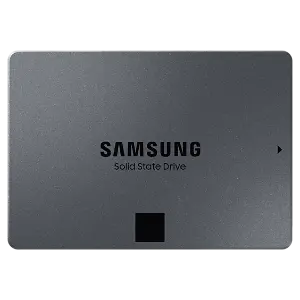
Specifications
| Interface | SATA 6 Gbps |
|---|---|
| Controller | Samsung MJX |
| NAND Type | Samsung 64-layer 3D V-NAND QLC |
| DRAM Cache | LPDDR4 |
| Warranty | 3 years |
| Active Power | 3.3 W |
| Idle Power | 0.05 W |
| Seq Read | 550 MB/s |
|---|---|
| Seq Write | 520 MB/s |
| Rand Read | 97,000 IOPS |
| Rand Write | 89,000 IOPS |
| Endurance | 360 TBW |
| Part Number | MZ-76Q1T0B |
| DRAM Cache | 1GB LPDDR4 |
| Seq Read | 550 MB/s |
|---|---|
| Seq Write | 520 MB/s |
| Rand Read | 97,000 IOPS |
| Rand Write | 89,000 IOPS |
| Endurance | 720 TBW |
| Part Number | MZ-76Q2T0B |
| DRAM Cache | 2GB LPDDR4 |
| Seq Read | 550 MB/s |
|---|---|
| Seq Write | 520 MB/s |
| Rand Read | 97,000 IOPS |
| Rand Write | 89,000 IOPS |
| Endurance | 1440 TBW |
| Part Number | MZ-76Q4T0B |
| DRAM Cache | 4GB LPDDR4 |
Overview
Released in November 2018, Samsung's 860 QVO was the manufacturer's first consumer drive to use QLC (4 bits per cell) V-NAND. It arrived in the same period as the Intel 660p, the first mainstream QLC NVMe drive. Samsung entered QLC in the SATA space, starting at 1TB and going up to 4TB.
QLC NAND stores four bits per cell rather than three, which reduces cost per gigabyte at the expense of write endurance and sustained write speed. Samsung addresses the write speed issue with Intelligent TurboWrite: a large SLC write buffer (up to 78GB on the 1TB model, higher on larger capacities) that absorbs sequential writes at close to MLC speeds. Writes that exceed the buffer fall back to native QLC speeds, which are much lower.
The drive uses the same MJX controller as the 860 EVO and 860 PRO. Its sequential speeds — 550 MB/s read, 520 MB/s write — match the EVO and are measured within the SLC buffer. The 860 QVO offered a more consumer-friendly cost per gigabyte than the EVO: it reached 4TB in 2.5" form when the EVO topped out at 4TB as well, but at a lower cost.
The warranty is 3 years, shorter than the 5-year coverage on the EVO line. Similarly, TBW ratings are lower for the QVO compared to the EVO at 360 TBW for the 1TB versus 600 TBW for the EVO 1TB. This is rarely an issue in consumer PCs but a problem for storage-intensive, professional use cases.
Reviews
-
“The 860 QVO performs better than many TLC-based drives, and even some of the older MLC ones.”
-
“The downsides of QLC NAND—be they mild or severe—are all accepted in exchange for the promise of affordability. Other things being equal, QLC NAND should ideally be 25% cheaper than TLC NAND. There are several reasons why this is an unobtainable goal at this point, but even accounting for those, the few QLC SSDs we have so far are all failing to deliver the improved affordability.”